

New Book Explains How AI Can Interrupt Brain Development in Students—And What Educators Must Do to Remedy This
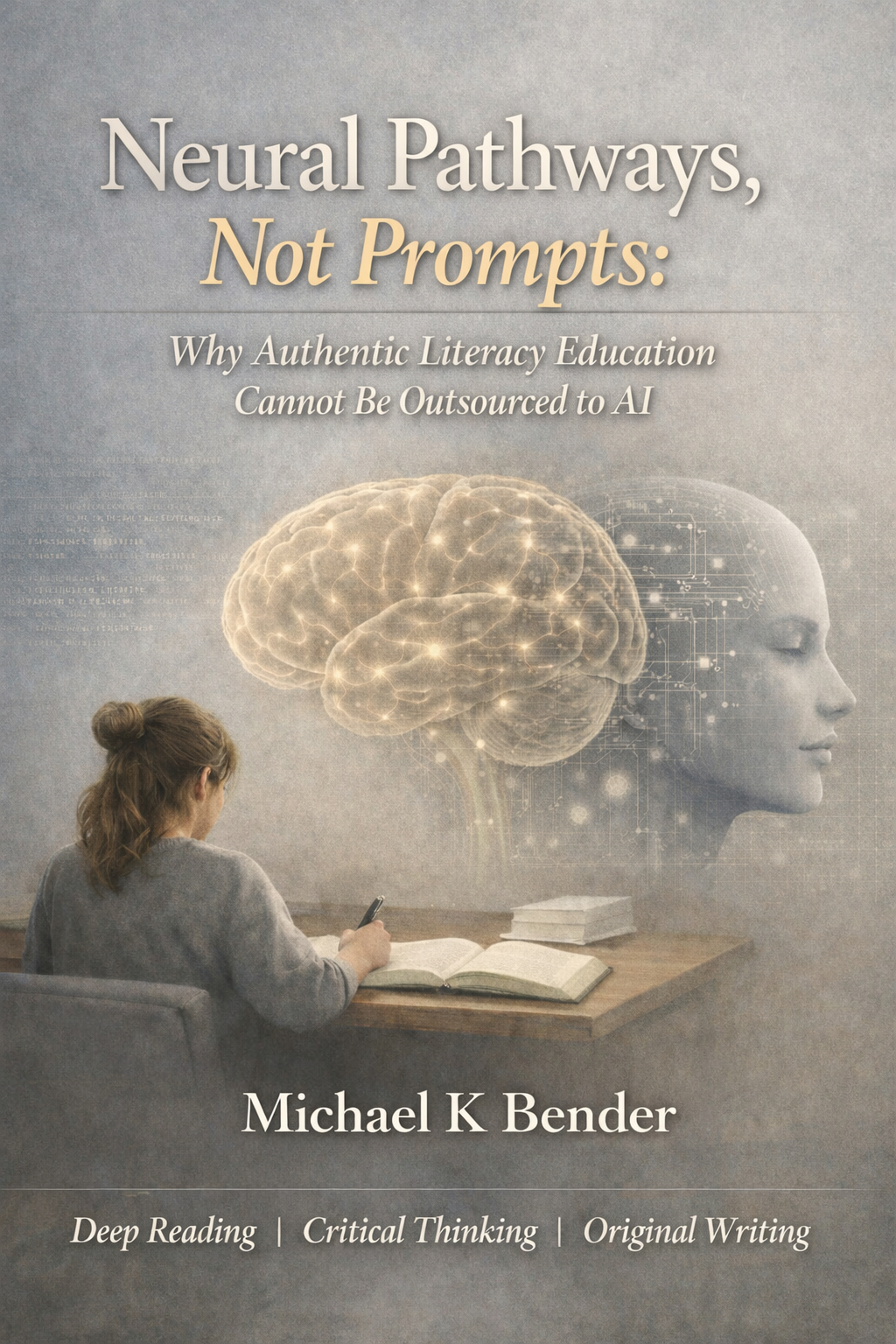
Neural
New book cautions that AI can disrupt students’ brain development and urges educators to protect authentic thinking through real reading, writing, and struggle.
“The question isn’t whether we can stop technology; the question is whether we understand what intellectual development actually requires and whether we’re willing to protect it.”
CAIRO, NY, UNITED STATES, May 21, 2026 /EINPresswire.com/ -- A new book cautions that the rapid rise of artificial intelligence in student writing and thinking is not merely a classroom challenge but a developmental crisis with long‑term consequences for intellectual capacity. "Neural Pathways, Not Prompts: Why Authentic Literacy Education Cannot Be Outsourced to AI," published by Amazon, argues that when students rely on AI to bypass cognitive effort, they interrupt the neural development that occurs through productive struggle, authentic writing, and deep reading.— Michael K Bender
The book arrives at a moment when AI adoption in schools is accelerating, often without a clear understanding of which intellectual capacities are being eroded. “This isn’t about cheating or grades,” author Michael K. Bender explains. “This is about neural development itself. When students use AI to bypass the productive struggle through which genuine thinking develops, they’re not just getting answers—they’re interrupting the brain’s physical adaptation that builds intellectual capacity. The crisis is invisible because students appear successful. They submit competent work and maintain good grades. But underneath, something crucial is not developing.”
Drawing on current neuroscience, Bender explains how intellectual capacity develops through repeated engagement with difficulty, confusion, and the effort to articulate original thinking. The book profiles students like Marcus, a college sophomore whose intellectual capacity quietly eroded through years of AI‑assisted work, and highlights classrooms where authentic thinking flourishes precisely because students are required to wrestle with challenging ideas.
Importantly, Neural Pathways, Not Prompts is not anti‑technology. Instead, it argues for clarity about what AI fundamentally cannot do: understand meaning grounded in lived experience, develop authentic voice, take intellectual stakes, or generate genuinely original thought. These limitations are not temporary technical gaps but boundaries between computational systems and conscious human beings.
“The question isn’t whether we can stop technology,” Bender writes. “The question is whether we understand what intellectual development actually requires and whether we’re willing to protect it. AI is remarkable at providing answers. But literacy education was never primarily about having answers. It was about developing the capacity to think for yourself.”
The book offers concrete, actionable guidance for educators, parents, and policymakers:
• For Teachers: Practices that protect productive struggle and make thinking visible, including close reading protocols, discussion structures, and revision‑centered pedagogy.
• For Parents: Strategies for supporting intellectual development at home without removing the difficulty that builds capacity.
• For School Leaders: Policy frameworks grounded in developmental science rather than efficiency or convenience.
• For Policymakers: Arguments for maintaining rigorous standards in an age
https://www.amazon.com/Neural-Pathways-Not-Prompts-Outsourced/dp/B0H26FPHLJ
Bender also traces the developmental trajectory from kindergarten through college, explaining how intellectual capacities build sequentially and why certain developmental windows are critical. When foundational work is bypassed, the consequences cascade: students who do not develop deep reading capacity in elementary school struggle with analytical thinking in middle school, cannot form original perspectives in high school, and arrive at college without the intellectual infrastructure needed for advanced work.
Despite the seriousness of the crisis, Bender emphasizes that recovery is possible. “Educators across the country are already doing this work,” he notes. “But it requires deliberate choice, sustained effort, and collective commitment. The work starts now.”
Neural Pathways, Not Prompts is essential reading for K–12 teachers and college faculty, school administrators designing AI policies, parents concerned about their children’s intellectual development, and anyone worried about what is lost when thinking is outsourced to artificial intelligence.
Michael Bender
Michael K Bender
518-704-1688
email us here
Legal Disclaimer:
EIN Presswire provides this news content "as is" without warranty of any kind. We do not accept any responsibility or liability for the accuracy, content, images, videos, licenses, completeness, legality, or reliability of the information contained in this article. If you have any complaints or copyright issues related to this article, kindly contact the author above.
